
Protection netting is a versatile solution used across many fields. While most commonly associated with construction sites, their applications extend much further. Choosing the right net depends on its intended use, material, and manufacturing technology. The real difference becomes clear on the product label. The EN 1263-1 standard clearly distinguishes between two terms often used interchangeably in everyday language: “net” and “safety net.” Below, we explain what protective netting is made of, what the letters and numbers on the label mean, how to verify whether a net is a certified safety net, and where these nets are applied.
Protective net, protection netting, safety net – what sets them apart?
In everyday language all three names sound the same thing. Under standard regulations, they are strictly defined. EN 1263-1 standard specifies two distinct product designations that differ by one critical element:
- Net — the designation contains the name, standard number, class, mesh shape and size and overall dimensions. It does not include a system designation.
- Safety net — Includes all of the above, plus an explicit system classification (S, T, U or V) and a production control level. A system represents a complete set of components forming an assembly that must be installed and used according to an operating manual.
This distinction is far from a mere formality. A system classification indicates that the manufacturer tested the complete installation method alongside the netting fabric itself. A net without a system designation may be made of high-quality material, yet it cannot legally be installed above a workplace to protect workers from falls. The practical rule is simple: if you need protective netting for a warehouse, sports hall, or pallet racking, a standard protective net is sufficient. If the net is intended to secure people against falls from height, it must be a certified safety net with a designated system.
What protective netting is made of: polyamide and polypropylene
Two polymers dominate the market. Polyamide (nylon) offers higher elasticity: the fiber stretches significantly before breaking, distributing impact energy more effectively. Its primary drawback is water absorption; wet polyamide absorbs moisture and increases in total weight. Polypropylene does not absorb water and is lighter, making nets easier to transport and handle, though the fiber itself is stiffer.
Material choice typically aligns with the weave type. Polyamide nets are generally manufactured as knotted netting, whereas polypropylene nets are usually knotless. EN 1263-1 standard specifies a clear requirement: mesh cord construction must consist of at least three independent strands woven so they will not unravel if cut. This ensures that an accidental cut remains isolated to a single mesh cell.
| Property | Polyamide (PA) | Polypropylene (PP) |
|---|---|---|
| Elasticity and energy absorption | higher — the fibre stretches a long way before it breaks | lower — the fibre is stiffer |
| Water absorption | absorbs water; a wet net is heavier | does not absorb water; the fibre is lighter than water |
| Net weight | bigger | lower — easier to handle |
| Usual construction | most often knotted | most often knotless |
| UV resistance | needs UV stabilisation | needs UV stabilisation |
| What EN 1263-1 says about the material | Nothing. The standard does not prescribe the raw material — it sets requirements for the result: the energy absorbed by the mesh, the mesh size, the strength of the ropes and the behaviour of the net after ageing. | |
Both materials lose strength under UV radiation. That is why the standard introduces the ageing factor γ₂, which is never lower than 1 and indicates at least 12 months of service.
The EN 1263-1 standard does not mandate a specific raw material. It sets performance-based requirements: required mesh energy absorption, maximum mesh size, rope tensile strength, and post-aging performance. Therefore, comparing polyamide versus polypropylene is less critical than verifying the net’s class and label.
Aging requires careful consideration, as it is the only time-dependent variable. The standard introduces a dedicated safety factor γ₂ describing netting degradation, stipulating that γ₂ cannot be less than 1 and reflects at least 12 months of operational use. Both polymers degrade under UV radiation; the determining factor is proper UV stabilization rather than inherent immunity to sunlight.
Mesh configuration: square vs. diamond, 60 vs. 100 mm
Mesh netting can be arranged in a square pattern (designated as Q) or a diamond pattern (designated as D). Mesh size is measured between opposite nodes and, combined with energy capacity, dictates the net’s performance class. The standard defines four primary classes based on energy capacity and mesh size:
| Class | Energy acting on the net | Maximum mesh size |
|---|---|---|
| A1 | EA = 2,3 kJ | 60 mm |
| A2 | EA = 2,3 kJ | 100 mm |
| B1 | EB = 4,4 kJ | 60 mm |
| B2 | EB = 4,4 kJ | 100 mm |
Classification under clause 4.1 of EN 1263-1. The letter stands for the energy, the figure for the mesh size. The mesh can be square (Q) or diamond (D).
In practice, Class A2 (square mesh up to 100 mm with an energy absorption capacity of 2.3 kJ) is the most widely deployed safety netting across construction sites. Classes with a 60 mm mesh size are specified less frequently, primarily when the netting must retain small falling objects in addition to providing personal fall protection. Regardless of class, net edges must be secured against fraying or unraveling.
A smaller mesh size does not automatically indicate a stronger net. Classes A1 and A2 feature the exact same energy absorption capacity (2.3 kJ) and differ only in mesh aperture size; the same applies to B1 and B2 pair at 4.4 kJ. Energy absorption capacity and mesh aperture size are two independent parameters.
Border ropes: the load-bearing backbone
While netting is often viewed as a mesh fabric, the border rope bears the primary load during a fall impact, transferring loads directly to the supporting structure. EN 1263-1 standard sets strict minimum breaking strength limits:
- K-type border rope: At least 30.0 kN, with end connections rated for at least 24.0 kN.
- P-type border rope: At least 20.0 kN, with end connections rated for at least 16.0 kN.
The standard notes that these values incorporate a mandatory safety factor of 2.0. Border ropes must be twisted or braided, and all rope ends must be finished to prevent unraveling. The minimum internal eye loop length is 150 mm. The netting mesh attaches to the boundary in one of two ways: directly to every mesh cord or by tying the border rope at intervals not exceeding 2.5 meters. The latter is the standard method on site.
How the border rope attaches to the structure defines the overall system. This applies to System S safety nets (where the border rope anchors directly to structural elements), as well as System T and System V safety nets (where consoles and brackets support the system).
How to verify whether protective netting is a certified safety net
Inspecting a safety net does not require specialized technical expertise; verifying two key elements provides immediate confirmation.
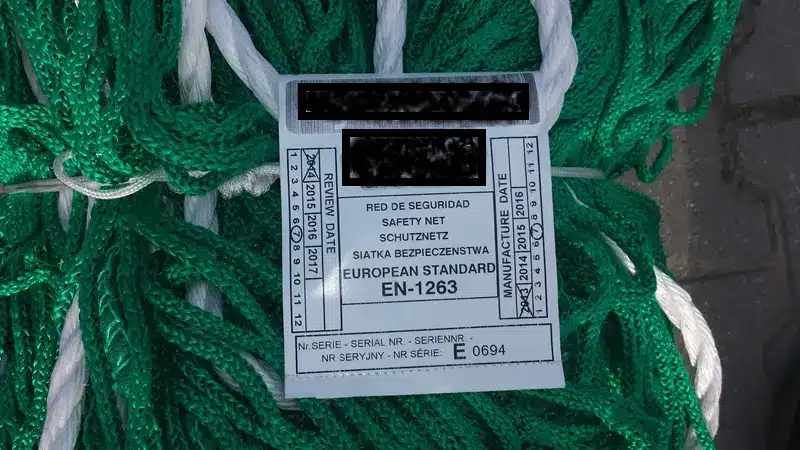
Permanent Product Labeling. EN 1263-1 standard defines an exhaustive list of required label information:
- Manufacturer or importer name and trademark
- Product designation (including system, class, and dimensions)
- Unique identification number
- Month and year of manufacture
- Minimum energy absorption capacity of the test mesh
- Manufacturer product code
- Independent inspection body mark (required for production control level M)
Markings must be permanent. The standard specifically cites stitched or riveted plastic tags that cannot be removed without damaging the net. Glued or tied paper labels do not meet permanent labeling requirements.
| Part of the designation | What it means |
|---|---|
| Safety net | the name of the product — a plain “net”; has no system, so it is not intended to protect a work position |
| EN 1263-1 | the number of the European standard the net was tested to |
| S | net system: S, T, U or V |
| A 2 | class: energy 2,3 kJ, mesh up to 100 mm |
| Q 90 | mesh shape (Q — square, D — diamond) and its size in millimetres |
| 10 × 20 | net dimensions in metres |
| M | production control level — it appears only where Annex B of the standard applies |
Designation under clauses 5.1 and 5.2 of EN 1263-1. A complete example: Safety net EN 1263-1 – S – A 2 – Q 90 – 10 × 20 – M. Ropes have their own designation, for example: Rope EN 1263-1 – K 15.
The Integrated Test Mesh (Sample Mesh)
Every certified safety net must contain at least one integrated test mesh. This consists of a short section of at least three meshes loosely woven through the perimeter edge of the main net. It must originate from the same production batch and carry an identification label matching the main net’s serial number.
Each year, one test mesh is cut from the net and submitted to a laboratory for energy absorption testing. This test verifies how much energy capacity the netting retains after exposure to sunlight, rain, and dust. Without a test mesh, annual re-certification is impossible, rendering the net unfit for further service. The absence of a test mesh is the fastest indicator that a net is not a certified safety net.
Additionally, every net must be supplied with an operating manual containing installation, usage, inspection, and dismantling instructions, test mesh inspection dates, retirement criteria, environmental hazard warnings, and a declaration of conformity. The manual must explicitly state that any net involved in arresting a falling person or heavy object must undergo formal inspection by a competent person before re-use.
Non-construction applications for protective netting
Outside of construction, protective netting is deployed wherever containment or barrier protection is required. The most common applications are:
- warehouses and industrial facilities — Rack guard netting to prevent palletized goods from falling,
- Logistics & Transport: Cargo securing nets for road, rail, and air freight,
- Sports Facilities: Ball catch nets and perimeter safety netting for fields and halls,
- Agriculture & Horticulture: Crop protection netting and bird barriers,
- Aquaculture & Fishing: Containment and commercial netting.
In these non-construction applications, EN 1263-1 standard does not apply, and the netting does not require a system designation or test mesh. However, on construction sites, netting serves as collective fall protection (CPE) and must meet full safety net certification. If you are looking for netting to protect work at height, check our dedicated page on safety nets for construction.
For debris containment, tool drop prevention, or formwork protection, specialized debris nets are used rather than personal fall arrest netting; we described it under protection against falling objects.
FAQ – frequently asked questions about protective netting
What is the difference between protective netting and a safety net?
“Protective netting” is a general term and covers various mesh products, from trailer covers to sports netting. A “safety net” is a strictly regulated term under EN 1263-1 standard, referring to a complete fall-arrest system tested alongside its attachment method (System S, T, U, or V). All safety nets are protective nets, but not all protective nets are certified safety nets. Only certified safety nets may be installed for personal fall protection at height.
Polyamide or polypropylene — which material should I choose?
Polyamide stretches more under load and absorbs impact energy effectively, but absorbs water, increasing wet weight. Polypropylene is waterproof and lighter, though stiffer. EN 1263-1 standard does not mandate a specific polymer; it enforces performance metrics including mesh energy absorption, aperture size, and rope tensile strength. Therefore, system class and proper labeling are more critical than base polymer choice.
What does the designation “EN 1263-1 – S – A 2 – Q 90 – 10 × 20” mean?
This code breaks down as follows: EN 1263-1 standard; System S (horizontal net with border rope); Class A2 (2.3 kJ energy absorption capacity with up to 100 mm mesh); Q 90 (square mesh pattern, 90 mm size); and dimensions of 10 × 20 meters. An additional letter “M” indicates level M factory production control under Annex B of the standard.
How often must construction safety nets be tested?
Certified safety nets must undergo annual re-certification. One test mesh (a 3-mesh sample woven into the perimeter with a matching serial number label) is cut and sent for laboratory testing to measure retained energy capacity after weathering. The manufacturer specifies test mesh inspection dates in the user manual.
Can a safety-net be re-used after arresting a fall?
Not immediately. EN 1263-1 standard requires that any net that has arrested a falling person or heavy object be removed from service and thoroughly inspected by a competent person before being cleared for further use, even if no visible damage is apparent.
Unsure whether you need an EN 1263 certified safety net?
If the net’s primary function is securing people against fall hazards, regulations classify it as collective fall protection (CPE), requiring full EN 1263-1 certification with an assigned system, permanent label, and test mesh. Contact us with your project details, and our technical team will advise on the correct system and class.
A full overview of the solutions, with the four systems of the EN 1263-1 standard, is on the safety nets for construction page.